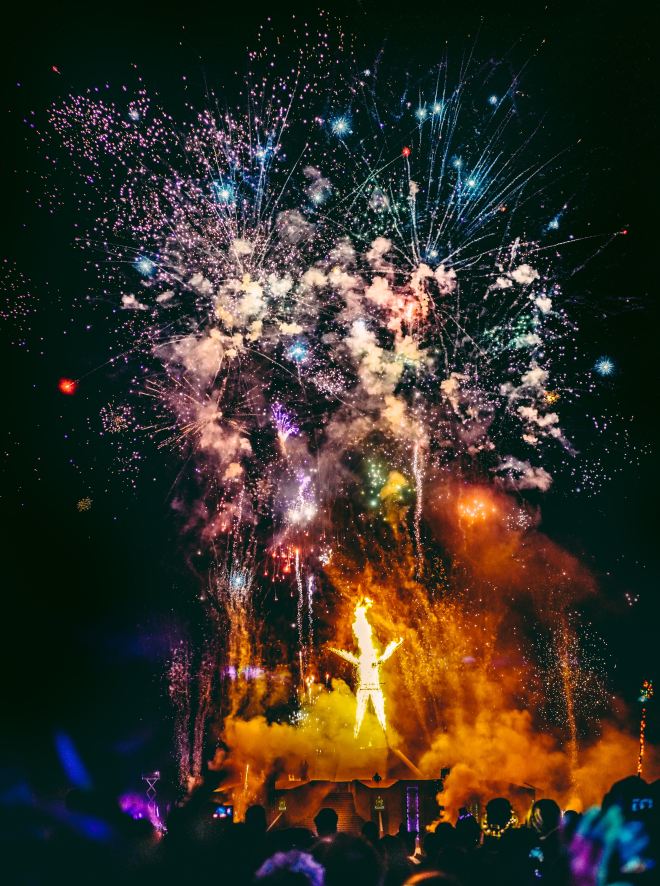
Photo by Sam Mathews on Unsplash
When I did an LED workshop at The Crucible in Oakland this summer, I heard a few adult women mention “Burning Man,” an annual gathering in the Black Rock Desert in Nevada that celebrates community, art, and self-expression. I bookmarked the festival, but never considered that I would run into Burning Man in the news this month! I was keen to research the debacle, but before that, I had to understand the roots of the Burning Man Festival.
The event dates back to 1986, when two men, Larry Harvey and Jerry James, from the San Francisco (SF) arts community built an eight-foot effigy of a man to celebrate the summer solstice in Baker Beach, San Francisco. Their tradition of constructing effigies continued for a few years until a new effigy five times the size of the original one was lit on fire. The so-called “immolation” (destruction of something by fire) of the effigy did not sit well with the police, who ended up prohibiting the structure from being set on fire.
Due to the conflict with the police, the founders resumed their tradition in the Black Rock Desert in Nevada on Labor Day and it stayed that way until now. Each year, there is a central theme around value systems cherished by ordinary citizens, such as ‘Good and Evil,’ ‘Fertility,’ ‘American Dream,’ ‘Hope and Fear,’ ‘Evolution,’ ‘Radical Ritual,’ and more. Here is some artwork produced this year. The artworks hail from different worlds, such as the blue LED “Elder Mother” from Hans Fairytales, the orange fire-spewing octopus “El Pulpo Magnifico,” ceremonial “Temple of Heart” to more straightforward art like the caroling romantic canvas “Fear Not” and reused penny-wise bear sculpture.” These artworks were hand-crafted by active attendees.
From its humble beginnings with twenty-four attendees to now attracting 50,000 participants, the event has consistently grown in popularity. The attendees engage in the festival through art installations or by participating in camp, all while adhering to the “self-sustenance” rule, which requires them to bring their own supplies for a week in the desert. This is how Burning Man evolved into a cultural movement that emphasizes creative expression through independence, teamwork, and contributions.
Although Burning Man is synonymous with freedom to most people, nature has had a different response. The first rainstorm in Burning Man occurred on August 25, 2014, causing cancellations of events and displacement of attendees to other campsites. This year, Reuters published a photo album where the images display the traffic from the event. From September 1, 2023, attendees had to walk through acidic mud and manage their necessities, as even the portable toilets were clogged. A few days after floods and rainstorms, 70,000 people continued to drive through the mud.
The initial purpose of the Burning Man Festival was to challenge the status quo of capitalism. However, the 2014 rainstorms to the recent exodus and environmental protests, raised the question: “Does Burning Man still burn with the dream of liberty?” For instance, in 2017, Burning Man generated $44.5 million in total revenue, and the shift to the Black Rock Desert introduced a $4 million charge for permits instead of the initial free tickets. Tickets to the festival can be expensive, and participants often spend a lot of money on food, camping gear, and other supplies. In addition, Burning Man has been criticized for its exclusivity as top-notch tech moguls and party-goers have increasingly dominated the audience, and unstable infrastructure has altered the meaning, diverging from the festival’s “Leave No Trace” slogan. Critics argue that the festival is not doing enough to make itself more inclusive and accessible to people from all walks of life.
Due to the problems experienced at the festival this year, there were many protests that responded to several concerns, including the event’s environmental impact, high cost, and lack of accessibility for people of color and low-income individuals. Nevertheless, these protesters blocked the roads leading to the event, causing a traffic jam, which involved county sheriffs.
Despite the fractures in the image of Burning Man, such as the muddy, challenging conditions resulting from climate change-affected roads, some Burners persevered—dancing to music, engaging with fellow campers, and offering mutual support. Keeping the celebratory spirit of some Burners, I propose a few healthy changes to implement such as charging less for driving/food, encouraging waste cleanups, starting the festival earlier to curb traffic, having basic guidelines for “Leave No Trace”, emphasizing that everyone at the event can do art despite size or equipment, providing opportunities for local neighborhoods, and allowing for free speech such as protest through art.
Although Burning Man has undergone drastic changes since its inception, I hope the festival will continue to light up the deserts during the darkest hours.
References:
https://www.theguardian.com/culture/2016/sep/05/burning-man-temple-project-death-mourning
https://www.britannica.com/art/Burning-Man
https://www.reuters.com/breakingviews/burning-mans-libertarian-dream-gets-reality-check-2023-09-05/
 The Roar