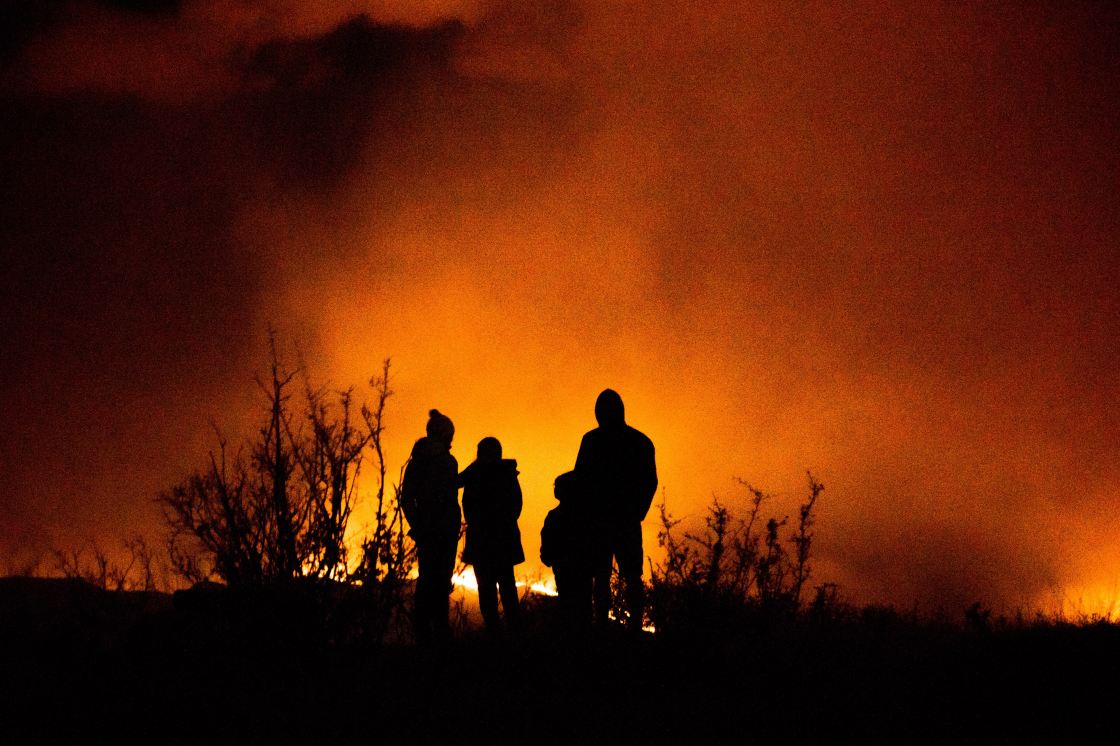
Unsplash – Caleb Cook – Family watching a wildfire
People described it as a freight train of fire barreling down the mountains, incinerating the entire town of Lahaina to nothing more than ash. Survivors recount that people were burning to death inside melting cars, jumping into the Pacific as boats around them burst into flame, and abandoning their pets with no other choice. Lahaina resident, Chelsea Denton Faqua, 32, told the New York Times, “It was like a flamethrower on the town. It was as if some person or mythical thing had a blowtorch and was just taking it to our whole entire town.”
The August 2023 fire that decimated Lahaina, once the capital of the Kingdom of Hawaii, is the deadliest wildfire the United States has seen in over a century. As of the publishing of this article, the death toll sits at 97 people, with many still missing. It’s estimated that the total damages exceed five billion dollars and will take years to rebuild. In the aftermath, Maui’s emergency management agency along with Hawaii’s primary electricity provider, Hawaiian Electric, are both under scrutiny for their roles in the fire. Allegedly, the fires were started by extreme hurricane-level winds blowing over power lines, and Maui’s government blames Hawaiian Electric for not shutting off the power. However, Hawaiian Electric claims they did shut it off and the fire was caused by a flare-up of a more minor fire earlier that day. Whatever the direct cause of the fire was, it is evident that Hawaii’s history over the past few centuries, along with the initial response to the disaster, were the main causes of death. A Lahaina resident, Mark Stefl, 67, was asked if authorities had sent any warnings or alerts about the fire that would ultimately cut the lives of 97 people short.
“Oh, hell no.”
Hawaii has the most advanced emergency siren system in the entire world, spanning the entire Hawaiian Archipelago. Maui County’s official website explains that the sirens are utilized to warn people about natural disasters, such as major storms, tsunamis, and wildfires. During the fire, the 80 sirens around Maui County stayed completely silent; the only warning came in the form of a cellphone alert. Breanna Gill, a tourist, recalled that the emergency warning from her phone woke her up from a nap at her hotel. She says that it may have saved her life, but wonders what would have happened if she had turned off her phone. Maui Emergency Management Agency Administrator, Herman Andaya, was asked if he regretted not activating the sirens. He claimed that he wasn’t because according to him, the sirens are mainly for tsunami warnings and residents are trained to move inland if the sirens are utilized. If he had sounded the alarm, people would allegedly have traveled straight into the heart of the firestorm. Andaya resigned the next day.
To fully understand all the factors that exacerbated the magnitude of the Lahaina fire’s devastation, it is important to examine how 19th-century colonialism in Hawaii transformed the natural landscape of Maui. Before the US took control of Hawaii, Maui was covered in lush wetlands, biodiverse food forests, and countless life-giving fishponds. Enticed by the temperate climate with abundant rainfall, wealthy sugar and pineapple plantation owners began establishing vast plantations in Hawaii, and the natural landscape of Maui was transformed beyond recognition. The plantation magnates, with the US’s help, eventually staged a coup against the Kingdom of Hawaii—which ultimately resulted in US annexation. Kamana Beamer, former member of the Hawaii Commission on Water Resource Management, commented, “You can see the link between extractive, unfettered capitalism at the expense of our natural resources and the ecosystem.” The waters of the plentiful ponds and streams were diverted to cultivate endless pineapple fields, and excessive pesticide use poisoned any water that remained. Maui began to transform into an island covered in dry grasslands due to the sudden lack of water, and highly flammable invasive grasses used as animal fodder quickly overtook native species. Maui’s Department of Land and Natural Resources operates on limited funds and private landowners don’t have enough incentive to control the non-native grasses, so over many years, Maui transformed from a lush, flourishing island to a dry, ready-to-burn field of invasive grasses.
After the last plantation closed down, land developers quickly purchased Maui’s massive swaths of land. Instead of enforcing proper land management policies, the capitalistic corporate powers who owned the land continued to exploit it for their own profit. Developers like West Maui Land Company Inc. used the already established irrigation systems to channel unfathomable quantities of water to its luxury resorts. Hōkūao Pellegrino, a Hawaiian taro farmer, has been severely impacted by how much water the resorts are using up; he calls it “disaster capitalism at its finest.” Pellegrino says to prevent future tragedies, Maui needs to revive the native wetlands and streams that were a natural blockade against disasters in pre-colonial Hawaii.
Although colonialism and profit motives from centuries ago paved the way for the horrific fire, it absolutely cannot be assumed that those motives don’t exist today. Less than twenty-four hours after the fire, many Lahaina residents reported that they started receiving messages from large land developers offering to buy their destroyed land. Even after the island had just experienced the deadliest wildfire nationwide in over a century, immoral, capitalistic land developers only saw cash and opportunity. They don’t give regard to the needs of the people, the grieving survivors who lost everything, and any of the historical importance of Lahaina. Instead, they want to capitalize on the devastation and grief of residents to convince them to sell their valuable land for extremely low prices. The land grab for Maui has gotten so extreme that Gov. Josh Green of Hawaii is trying to enact a moratorium on all land transactions in the areas in and around Lahaina. “Don’t approach them with an offer to buy land. Don’t approach their families to tell them they’ll be better off if they make a deal.” However, experts are saying that it is unconstitutional to pass an outright ban on all land transactions, even if it’s only for a period of time, because people deserve the option if they truly need to.
Lahaina residents have taken to social media to make it clear that their sacred land is not for sale, and are protecting one another from agreeing to any of the deceitful offers. The people of Lahaina know that if they relinquish their land, a future, fully-rebuilt Lahaina won’t reflect the cultural and historical meanings it once had, and will instead be yet another over-developed and artificialized tourist attraction. Lahaina isn’t just a home for its residents; it reflects hundreds of years of Hawaii’s colorful pre-colonial history and culture, with many areas that are extremely sacred and spiritual to the Native Hawaiians.
People will disagree about how the Lahaina fires were caused, but there is no doubt that the systemic institutions of colonialism and capitalism exacerbated the destruction of this fire and led to its massive death toll. These institutions were a problem, are a problem, and will be a problem if we don’t recognize it as a real problem. This isn’t unique to Hawaii either. History always repeats itself, and more disasters stemming from the practices of unfettered capitalism will occur, especially if it continues this way. While the corporate elite take advantage of this unregulated capitalism to exploit resources and gain large profits, people will pay the price of that with their lives.
 The Roar